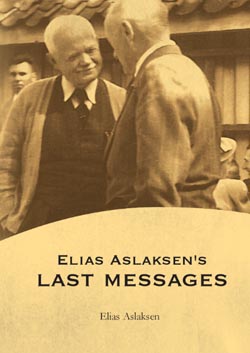
A Sense for the Things of God
By God’s great grace I have a particularly rich and powerful text for everyone who is really receptive. It is quite out of the ordinary. It’s a familiar verse that we have all, unquestionably, gotten all too little out of.
Mark 8:32-33: “. . . and Peter took him, and began to rebuke him.” Peter, the poor, pitiful creature that he was at that time—so pathetic and afraid for his life that he lied several times and even cursed and swore that he didn’t know Jesus—this was the pitiful creature that took Jesus aside and began to correct Him. Perhaps you have thought all too little about this! Jesus had chosen Peter; he was a chosen vessel. But he was way off course and fell pathetically short. Then it’s written about Jesus in verse 33, that He said to Peter, “Get behind me, Satan!” He wasn’t rebuking Peter for being Satan, but Peter’s condition was so incredibly bad that what he was warning Jesus against was the very work of salvation itself. Of course, he did this with the very best of intentions, in all good faith, and thought he had true care for Jesus. The darkness that Peter was in was so great that he exhorted Jesus not to do God’s will, and he did it only out of loving care, wanting to spare Jesus—and Jesus called that “Satan.” Peter was in the service of Satan but believed that he was serving God. He was really in darkness.
Verse 33: “. . . for you do not have a sense for the things that belong to God” (Norwegian). It can be like that for very well-meaning brothers and sisters. They seek God and pray to Him and want to be saved, but their development is such that they do not possess a sense for the things that belong to God—the things that God has a sense for. But rather, “. . . only for the things that are of men” (Norwegian). Maybe you even imagine that you have a sense for spiritual things, while the truth is that you lack a sense for the things that belong to God. And what is it that people have a sense for? Everyone understands this quite well, if you just think about it. Take a piece of paper and a pencil and think about all the things that human beings have a sense for. Write them down and read them often in order to get light over all the things that you still have a sense for—the things that human beings have a sense for. This will be a great help in coming to self-acknowledgment, and we can only be saved to the degree of our self-acknowledgment. We can’t ask Jesus to save us from something we believe is right; that is pointless. When I believe that what I am doing is right, then I can’t be saved from it. There is no possibility of partaking of more salvation unless I understand that something of what I do is wrong. We need to get new light, true divine light. This human sense is a dreadful thing. It causes us to work in opposition to God; we oppose our own salvation—prevent our own salvation, when we are supposed to be working out the salvation of our souls.
What God has a sense for is the exact opposite of what people have a sense for. For example, the words of Jesus, “. . . whoever humbles himself will be exalted.” Matt. 23:12b. God has a sense for us humbling ourselves, and He is so interested in this, that if we do it, He will exalt us even if we ask to avoid being exalted. He Himself will exalt us because that is in accordance with His taste and mind. And the opposite: “. . . whoever exalts himself will be humbled.” Matt. 23:12a. God can’t allow it to be otherwise. And when a person is humbled, if we believe this scripture, then we know that the person concerned has exalted himself. Even though we might not have seen it or known about it, it has to be true because this is a constant, unalterable law of life. What God has a sense for is that we should be thoroughly saved. And that can only happen if we get a living faith in God’s Word and obey it. How many people do you think there are who have a taste for, and an interest in, humbling themselves? Almost none. What do people have a sense for? One thing is, that no one should know how bad it is with them. They smile and act and pretend like nothing is out of order. That’s what people have a sense for, and they use that sense.
There’s almost no one who asks anyone else for forgiveness for anything. They think that if they ask for forgiveness, they will be less esteemed by the other person. True, you will be less esteemed by all foolish people when you acknowledge your sin. But, just as certainly as you will be less esteemed by all foolish people when you acknowledge your sin, just so certainly you will increase tremendously in esteem with God. But people don’t have a sense for this. They don’t think about the fact that they will increase in esteem with God. But it is obvious that by humility and abasing yourself in acknowledging the truth as it is, you increase in esteem with God. Forget about the dishonor of foolish people because you will be honored by God, and that is the only significant thing. It pays to be “good friends” with God. Here is a striking comparison. Paul wrote to a church that had been established through his work, “You look only at the outward appearance.” 2 Cor. 10:7 (Norwegian). But Socrates looked only at what was on the inside. Socrates prayed to God to be beautiful on the inside, and he didn’t have one single Word of God. But he sought God so intently that god was obliged to reveal Himself to Socrates, to a tremendous degree. Socrates didn’t know one single scripture!
Paul wrote to the Corinthian church—who had been instructed by him, and who had the same training and knowledge as he had. The testimony of Christ was established in them; they lacked none of the gifts (they were especially enamored with speaking in tongues). Paul writes to such people, “You look only at the outward appearance.” This needs a little explaining. Even when it concerned the inward things and life, they thought about what kind of impression it made, how it sounded to people, and what people thought and felt about it. In this way even these inward things became outward. It’s possible to speak in a way that sounds very beautiful, so that foolish people get the impression that this is really something, without there being anything particularly glorious on the inside. When, for example, people spoke in tongues until they were beside themselves, all the foolish listeners were quite impressed by how full of the Spirit these people were—surely these people were something special. But Paul writes that there was division and envy among them. One supported Paul, and another Peter, and a third Apollos. They were carnal, and so it wasn’t possible to speak to them as to spiritual people.
There is something called “making an impression.” You can do that with knowledge and giftedness and the like. You impress all foolish people because they have a sense for appreciating such things. One can work up a terrific atmosphere with shouts of hallelujah and then think there’s a tremendous spirit present. The Holy Spirit is the Spirit of truth—but this isn’t true and genuine, it’s more theatrical! Many of the friends are interested in outward things, in earthly things! People admire and look up to earthly things; that’s how deep one can sink, even right in the midst of the church. We should worship God in Spirit and truth; we ought to worship Him for the understanding He has of how to save us, and not just that He has that understanding, but that He implements it, if we are receptive. People worship nice clothes and nice things. But God wants true worshippers who will worship Him in Spirit and in truth. In the first chapter of Romans, it is written about those who worship the creature—almost everyone does that—instead of the Creator.
Isaiah 2:12-16. “. . . over all that is beautiful to behold” (Norwegian). So many things are beautiful and they make such an impression. How much transformation of the inner man will you be brought to by admiring such things? The truth is that the more such things mean to me, the less I have within which is of any significance. The outward things cannot increase my happiness in the slightest! You can rejoice when you receive a gift, maybe a flower, but the flower doesn’t increase your joy if you have a whole garden of flowers on the inside. It’s written in Sirach that the fear of the Lord is like a garden of flowers. When you fear God with all your heart, you will be thoroughly saved, and then you will have a garden within. This is the Word of God. God is the same yesterday and today; He hasn’t changed His taste. He has exactly the same tastes as He had in the days of Isaiah, and as He had in the days of Paul—who exhorts in Romans 12 that we should keep ourselves to lowly things (Norwegian). But not only that, it’s written that we should have a preference for lowly things. Do people have a sense for that? No, the exact opposite; that’s why he gave the exhortation.
Isaiah 3:16-24. God’s fierce wrath is over vanity, over making a good impression, over the admiration of earthly things. But not only that, His wrath is stirred because we are so occupied with how our words sound, how we look, and what people think. His wrath is over our occupation with what people feel about what we do or say—instead of our only being interested in becoming beautiful on the inside, becoming transformed inwardly, and becoming godly inwardly—completely and entirely! That’s what God has a sense for. That’s what He is interested in. If we are interested in the other things, the outward things, then we are still way off. A person’s state or condition can be so bad that about the worst thing imaginable for him is to acknowledge, to confess, and to humble himself. Then, spiritually speaking, that person is out of commission—kaput. God gives grace to the humble and resists the proud. What does it say about me if I regard humbling myself and acknowledging things as they are, as about the worst thing I can imagine? People will do almost anything to keep other people from getting even the slightest inkling that they aren’t all that they appear to be. In other words, their state is so bad that they see as the worst thing imaginable, what, in reality, is the very best thing. Here is a tremendous opportunity to really work out the salvation of your soul. This is the very core of all salvation. It isn’t possible to have a good conscience when you know that people think better of you than you actually are. You have to harden yourself to your conscience—you have to bring it to silence. Inwardly, I have and have had for many, many years full mobilization against this—before anything has arisen. I couldn’t bear to live one day if there was anything in what I said or in the way I conducted myself that gave a better impression of me than was actually the case. I couldn’t stand it! It just couldn’t happen.
“Get behind me, Satan! For you do not have a sense for the things that belong to God, but only for the things that are of men.” What do people have a sense for? They have a sense for being well-liked, for being honored and so on. But the only thing that matters is what God thinks. This is very obvious. Even if you are young, work with this the rest of your life. When you have this sense for the things that are of men, you get involved in hypocrisy. The best definition of hypocrisy is the word “pretend,” and people do that in many different ways. They pretend that it’s better with them than it is. You are happy to be regarded as something more than you actually are. You should hate that. That’s what it is to have a sense for being thoroughly saved.
People have a sense for what is fashionable. Almost everyone is a slave to fashion. One thing that isn’t fashionable is to ask for forgiveness. It almost never takes place, but what does happen is that people sin against one another and don’t ask for forgiveness. Why not? Because they believe that to ask for forgiveness will cause them to be less highly esteemed by others, and then others will also know that they have done something wrong. But then I will grow tremendously in God’s eyes, and He is the one who has all power in heaven and on earth, so it pays to grow in esteem in His eyes. These two things are complete opposites—the sense for the things that belong to God, and the sense for the things that belong to men—complete opposites, when it concerns the inner things and when it concerns the earthly things. My personal testimony is that from the time I was converted, I haven’t had any interest at all in earthly glory. I have lived completely and entirely in accordance with this. There are only two things to choose between, the heavenly and the earthly. To have a sense for receiving honor from men and concealing one’s sin, and so on, is as earthly as it can possibly be.
As soon as something new and modern appears in the world, it comes straight into the church, in spite of the so-called strong preaching that there is among us—so it probably isn’t nearly as strong and sharp as it should be. Take for example a few years ago when people began to decorate the open-faced sandwiches [open-faced sandwiches are common in Norway]. In my eyes, this looked like a manifestation of mental illness. It found its start right in the darkness of the world, but it wasn’t long before it could be seen round-about at feasts among the friends. I have spoken against it time and time again. What are we to do with this kind of thing when we consider the scripture which says that God wants people who will worship Him in Spirit and in truth? I earnestly hope and desire, in all of my simplicity, that you will follow my good advice. Sit down and write a detailed list of everything that human beings have a sense for; carry it in your Bible and work with it. We are supposed to work out our salvation, as it’s written, with fear and trembling. Why should we fear and tremble? We should be in fear and trembling about getting things in proper order so that we can be raptured when Jesus comes—otherwise we won’t be taken! He isn’t going to have a mediocre bride; no, He will have a bride that is all beautiful within, one who disregards the outward things, as He Himself does.
I hope it succeeds for each one of you. Now is the time of opportunity—extra opportunities in light of this amazingly pertinent text.
'%3e%3cpath%20d='M6.54486%2022.9268C6.54486%2022.9268%206.53328%2022.9268%206.52749%2022.921L6.3789%2022.8188C6.36732%2022.811%206.36346%2022.7975%206.36732%2022.784C6.65292%2021.8925%206.79958%2021.3985%206.80151%2021.3946C7.50006%2019.1542%207.57532%2016.4585%207.01956%2013.6044C6.67222%2011.8233%206.53907%209.51924%206.53714%209.49608C6.32294%205.48423%207.3534%203.6568%207.98827%202.92351L8.02687%202.91772L8.17931%203.00456C8.19089%203.01228%208.19668%203.02579%208.19282%203.0393C7.99406%203.68189%207.87056%204.34956%207.87056%204.35535C7.42866%207.10132%207.83583%2012.0433%208.24878%2014.5172C8.67332%2017.0625%208.38579%2019.2411%208.38386%2019.2623C8.03073%2021.4274%207.09289%2022.483%206.56608%2022.9191L6.54678%2022.9268H6.54486Z'%20fill='black'/%3e%3cpath%20d='M17.0135%2026.4292C17.0135%2026.4292%2017.0019%2026.4292%2016.9961%2026.4234L16.8475%2026.3212C16.836%2026.3134%2016.8321%2026.2999%2016.836%2026.2864C17.0772%2025.5377%2017.2219%2025.0591%2017.2605%2024.9318C17.9648%2022.6682%2018.0439%2019.9609%2017.4882%2017.1088C17.1408%2015.3257%2017.0077%2013.0236%2017.0058%2013.0004C16.7896%208.9519%2017.8259%207.13604%2018.4627%206.41241L18.5013%206.40662L18.6518%206.49538C18.6634%206.5031%2018.6692%206.51661%2018.6653%206.53205C18.4646%207.17464%2018.3392%207.85582%2018.3392%207.86161C18.0845%209.4459%2018.1308%2011.6245%2018.2138%2013.1741L18.2215%2013.3227L18.3527%2013.2532C19.6437%2012.5797%2020.7069%2011.9005%2021.3708%2011.4509L21.4113%2011.4547L21.5271%2011.5782C21.5367%2011.5898%2021.5386%2011.6072%2021.5271%2011.6187C20.4464%2012.983%2018.4318%2014.4554%2018.3469%2014.5172L18.3141%2014.5422L18.3083%2014.5828C18.4125%2015.8641%2018.5572%2017.0779%2018.7136%2018.0234C19.1381%2020.5687%2018.8506%2022.7493%2018.8486%2022.7705C18.4955%2024.9356%2017.5577%2025.9912%2017.0309%2026.4273L17.0116%2026.435L17.0135%2026.4292Z'%20fill='black'/%3e%3cpath%20d='M10.9639%2028C10.9639%2028%2010.9484%2027.9981%2010.9446%2027.9923L10.8076%2027.8707C10.7979%2027.8611%2010.794%2027.8476%2010.7998%2027.836C11.2919%2026.5778%2011.5756%2025.804%2011.6277%2025.6612C12.7874%2022.5891%2012.9129%2018.9014%2011.9885%2014.9957C11.4116%2012.5566%2011.1877%209.39959%2011.1858%209.37064C10.7844%203.16664%2013.0344%200.750655%2014.0205%200H14.0591L14.198%200.111923C14.2077%200.121571%2014.2135%200.135079%2014.2077%200.148587C13.8005%201.09221%2013.5227%202.31564%2013.5207%202.32722C12.7874%206.08821%2013.4609%2012.8538%2014.1479%2016.2442C14.8561%2019.7389%2014.3756%2022.7203%2014.3717%2022.7512C13.704%2026.1185%2011.7782%2027.5407%2010.9812%2027.9961L10.9658%2028H10.9639Z'%20fill='black'/%3e%3c/g%3e%3cdefs%3e%3cclipPath%20id='clip0_3867_12532'%3e%3crect%20width='28'%20height='28'%20fill='white'/%3e%3c/clipPath%3e%3c/defs%3e%3c/svg%3e)