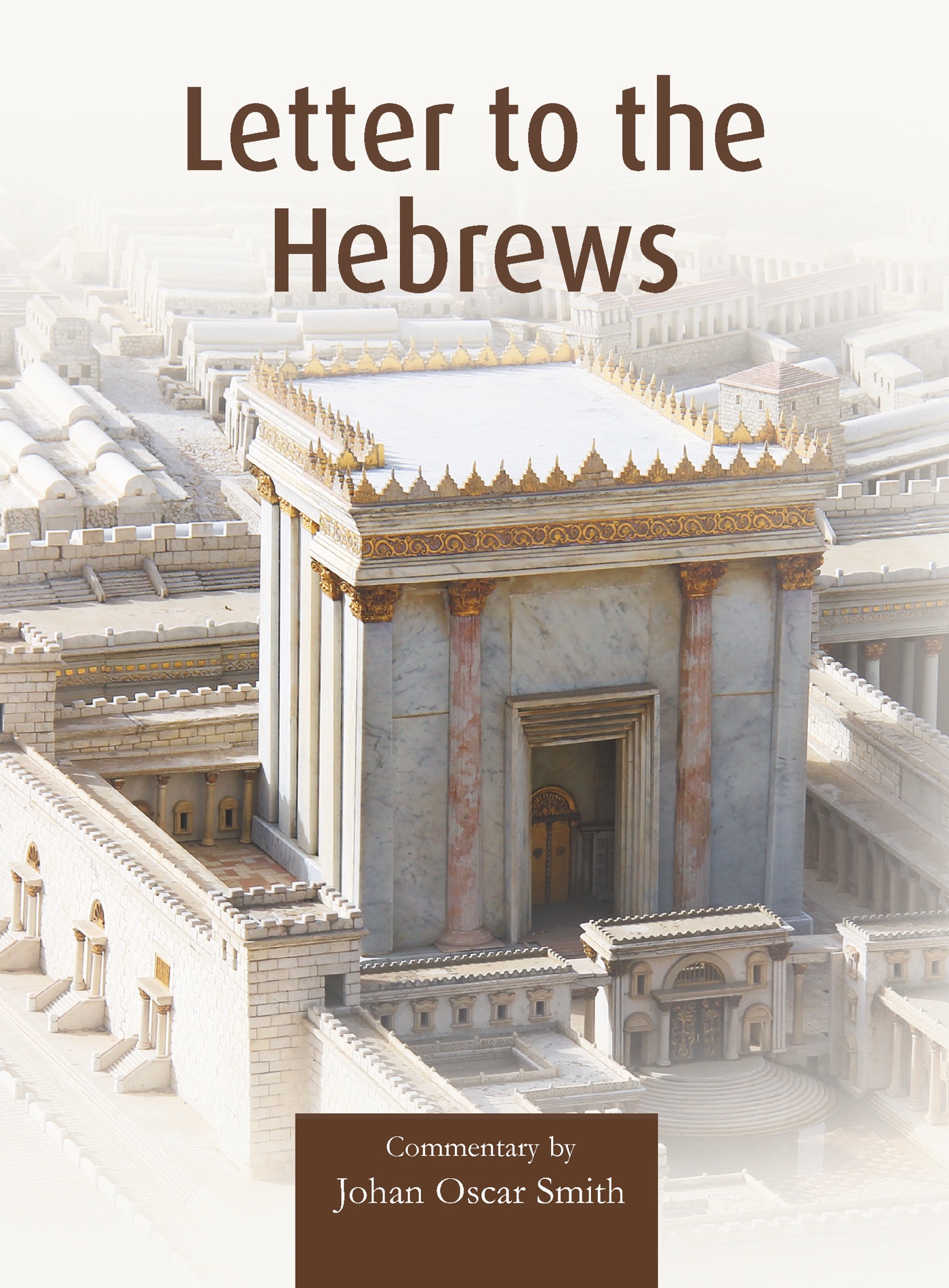
Chapter XIII
Verse 1. “Let brotherly love continue.” This exhortation tells us that we can be diligent to love the brothers. We must do that, because it is Jesus’ command. When unrighteousness abounds, love grows cold. So be righteous toward the brothers. Do everything you can to make Christ’s law of love work as a leaven in the brotherhood. Then fellowship with the Father, the Son and the church will increase. The kingdom of God will flourish, and the Prince of Peace will reign among us.
Verse 2. “Do not forget hospitality, for by so doing some have unwittingly entertained angels.” Be hospitable without complaining. Open your door to servants of the Word, and to others who need a place to stay. We only live once, and the day that has passed will never return. So do good while you are still alive, for your reward will be according to your deeds. Without knowing it, some have entertained angels. Without knowing it, you can receive servants of God into your house who can be of eternal blessing to you and your family. For it is written, “He who receives you receives Me, and he who receives Me receives Him who sent Me.”
Verse 4. “Marriage is honorable among all . . . .” This means let marriage be undefiled by flesh and spirit, so that love in the spirit does not degenerate into a love according to the flesh. Here we need to be alert.
Verse 5. “Let your conduct be without covetousness; be content with such things as you have. For He Himself has said, ‘I will never leave you nor forsake you.’”
The love of money is a root of all kinds of evil. Because of it, unrighteousness rules and the oil of gladness is lost. Every good gift and every perfect gift is from above and comes down from the Father of lights, with whom there is no variation or shadow of turning. A person who loves money is incapable of giving a good and perfect gift, so he sows sparingly and he will also reap sparingly.
Nabal was struck down by the Lord and died because of his greed, but his wife was blessed because she came to David and his men with food at the right time. If you want your righteousness to endure forever and your memory to be blessed, then give what you have liberally while you are alive, for no one can do any good in the grave. Besides, silver and gold belong to the Lord, and if you have some, that means that you have received a gift over which you are to be a faithful steward. We are to serve one another with the gifts we have received. When we live frugally, it does not take so much to get by. Godliness with contentment is great gain.
Verse 7. “Remember your guides, who have spoken the word of God to you, whose faith follow, considering the outcome of their conduct.”
After speaking about the love of money, the apostle exhorts us to remember those who have given us guidance, who have spoken the word of God to us. This is another way of saying: “You shall not muzzle an ox while it treads out the grain,” and “the laborer is worthy of his wages.” No one can speak the word of God unless he has been sent. And when he gives you spiritual goods, is it such a great thing if you give him some of your temporal goods? When you see the outcome of their conduct, follow their faith. Not all have the same works, but all have faith. Those who spoke the word of God to you followed the faith they had, and you who have not been sent, but live a godly life, are following your faith. Those who have spoken the word of God to you are your examples when you see the outcome of their lives. For truly every seed is in danger right until the harvest.
Verse 9. “Do not be carried about with various and strange doctrines. For it is good that the heart be established by grace, not with foods which have not profited those who have been occupied with them.”
The word of God is food; it is spirit and life. These various and strange doctrines lead people astray. Haven’t we seen this? We certainly have. The word of God is never wrong. These other doctrines appear to be food, but they are only dry teachings—head knowledge—and have not profited anyone. Jesus’ words are spirit and life, and they create fellowship in the Spirit and fellowship in life. When it says that it is good that the heart is strengthened with grace, then it means with the revelations of Jesus Christ. Dry doctrines contain neither grace nor revelation—only delusion. Jesus says, “My sheep hear My voice.” But the voices of these various doctrines lead people away from hearing the voice of the Chief Shepherd to listening to the voices of self-appointed hirelings and preachers out to make a living, whose words are far from spirit and life. Beware of them!
Verse 10. “We have an altar from which those who serve the tabernacle have no right to eat.”
Serving the tabernacle is an outward service. In the old covenant, sacrifices and meat offerings were offered on this altar for the forgiveness of sins. However, now in the new covenant, the completed work of Christ has been reduced to the forgiveness of sins—just the forgiveness of sins—or serving the tabernacle as in the old covenant. Nevertheless, Jesus is the way, the truth and the life. He will lead us to all the truth.
Just as there is an altar for outward service, there is also an altar for inward service. The forgiveness of sins is a washing of the body with pure water, because every sin that a man commits is outside the body. But walking in the light just as He is in the light gives the blood of the inner life opportunity to cleanse away all sin.
We have a right to eat of this altar. But those who only serve the tabernacle have no right to eat of this altar, because the enmity (the flesh) opposes this service.
Verse 11. “For the bodies of those animals, whose blood is brought into the sanctuary by the high priest for sin, are burned outside the camp.”
In the old covenant (the shadow), the high priest took the blood of the animal into the sanctuary, and the body was burned outside the camp. It is just the same in the new covenant. The body must be taken outside the camp, away from all the religiosity that goes on in religious sects and denominations, to Him—outside the camp—in order to suffer and die together with Christ, to resist sin unto bloodshed, to be conformed to the image of the Son. Then our heavenly High Priest takes that blood into the sanctuary. The soul is in the blood. Jesus poured out His soul to death. The first Adam was a living soul, but the second Adam became a life-giving spirit. Our spirit is to be made alive and our soul is to be poured out. Our life in this world is in the soul. We must lose our lives in order to find life. The blood is taken by the High Priest into the sanctuary. Here we will receive our souls once more at the resurrection of the dead, when body, soul and spirit are reunited.
While we are on earth, the body is dead because of sin, but the spirit is life because of righteousness. This body is now presented to God as a pleasing sacrifice, and this is our spiritual worship.
Verse 12. “Therefore Jesus also, that He might sanctify the people with His own blood, suffered outside the gate.”
The people are inside the camp. All of the twelve tribes of Israel were there. But He who was to sanctify the people with His blood, Jesus Christ, had to suffer and die outside the camp. Note the phrase: “Sanctify the people”! This is the service of the tabernacle, the outward cleansing.
Verse 13. “Therefore let us go forth to Him, outside the camp, bearing His reproach.”
Jesus is still outside the camp, and it is a reproach to go out there and be conformed to Him. There is no reproach in staying in some denomination, but if you truly go out to Him—outside the camp—then the reproach begins.
The work goes on outside the camp; it can never take place inside. It is there, on the outside, that God has ordained the blessing. That is the place where the Lord reveals Himself. Harlotry can never flourish there, because there is a cross, a death and blood over all flesh, but for the spirit, it is glorious.
Verse 14. “For here we have no continuing city, but we seek the one to come.”
This was also the faith Abraham had, the way he thought. He was waiting for the city with eternal foundations, whose builder and maker is God. That is why he was a stranger and a pilgrim in the Promised Land. This is precisely our situation. We are strangers and pilgrims in the world.
Verse 16. “But do not forget to do good and to share, for with such sacrifices God is well pleased.”
There are many things of which we need to be reminded. Among them is doing good and sharing with others. There is a sacrifice in this, too. That is why it is written, “With such sacrifices God is well pleased,” and “Who sends rain on the just and on the unjust.”1
Verse 17. “Obey those who are your guides and be submissive, for they watch out for your souls, as those who must give account. Let them do so with joy and not with grief, for that would be unprofitable for you.”
No one can be a guide for others unless he himself is being led by the great Chief Shepherd.
Before Peter could feed and watch over the sheep and the lambs, he had to promise Jesus that he loved Him more than them.
In Ezekiel 44:10 ff., it speaks of shepherds who clung more to the people than to the Lord. The people had money and food, so the priests went along with them. They loved their own bellies more than God and His commandments. They were priests for the people. They were not true guides, because it was the people who were guiding them.
However, the Levitical priests, the sons of Zadok, stood firmly with the Lord when the people went astray. Because of that, they were appointed to be priests for God and to take care of the things He wanted to be cared for. They were the true guides. Read from verse 15.
Verses 20-21. “Now may the God of peace, who brought up our Lord Jesus from the dead, that great Shepherd of the sheep, through the blood of the everlasting covenant, make you complete in every good work to do His will, working in you what is well pleasing in His sight, through Jesus Christ, to whom be glory forever and ever. Amen.”
Here God is called the God of peace, who brought up the great Shepherd of the sheep from the dead through the blood of the everlasting covenant. Blood had to flow before God could be called the God of peace. God’s will had to be done unto bloodshed. That is why these three must testify: the Spirit, the water and the blood. It was for the sake of this testimony that John was exiled to the island of Patmos, where he saw wondrous things that reached far into eternity.
God give us all grace to hold firmly to the Word and to the testimony!
'%3e%3cpath%20d='M6.54486%2022.9268C6.54486%2022.9268%206.53328%2022.9268%206.52749%2022.921L6.3789%2022.8188C6.36732%2022.811%206.36346%2022.7975%206.36732%2022.784C6.65292%2021.8925%206.79958%2021.3985%206.80151%2021.3946C7.50006%2019.1542%207.57532%2016.4585%207.01956%2013.6044C6.67222%2011.8233%206.53907%209.51924%206.53714%209.49608C6.32294%205.48423%207.3534%203.6568%207.98827%202.92351L8.02687%202.91772L8.17931%203.00456C8.19089%203.01228%208.19668%203.02579%208.19282%203.0393C7.99406%203.68189%207.87056%204.34956%207.87056%204.35535C7.42866%207.10132%207.83583%2012.0433%208.24878%2014.5172C8.67332%2017.0625%208.38579%2019.2411%208.38386%2019.2623C8.03073%2021.4274%207.09289%2022.483%206.56608%2022.9191L6.54678%2022.9268H6.54486Z'%20fill='black'/%3e%3cpath%20d='M17.0135%2026.4292C17.0135%2026.4292%2017.0019%2026.4292%2016.9961%2026.4234L16.8475%2026.3212C16.836%2026.3134%2016.8321%2026.2999%2016.836%2026.2864C17.0772%2025.5377%2017.2219%2025.0591%2017.2605%2024.9318C17.9648%2022.6682%2018.0439%2019.9609%2017.4882%2017.1088C17.1408%2015.3257%2017.0077%2013.0236%2017.0058%2013.0004C16.7896%208.9519%2017.8259%207.13604%2018.4627%206.41241L18.5013%206.40662L18.6518%206.49538C18.6634%206.5031%2018.6692%206.51661%2018.6653%206.53205C18.4646%207.17464%2018.3392%207.85582%2018.3392%207.86161C18.0845%209.4459%2018.1308%2011.6245%2018.2138%2013.1741L18.2215%2013.3227L18.3527%2013.2532C19.6437%2012.5797%2020.7069%2011.9005%2021.3708%2011.4509L21.4113%2011.4547L21.5271%2011.5782C21.5367%2011.5898%2021.5386%2011.6072%2021.5271%2011.6187C20.4464%2012.983%2018.4318%2014.4554%2018.3469%2014.5172L18.3141%2014.5422L18.3083%2014.5828C18.4125%2015.8641%2018.5572%2017.0779%2018.7136%2018.0234C19.1381%2020.5687%2018.8506%2022.7493%2018.8486%2022.7705C18.4955%2024.9356%2017.5577%2025.9912%2017.0309%2026.4273L17.0116%2026.435L17.0135%2026.4292Z'%20fill='black'/%3e%3cpath%20d='M10.9639%2028C10.9639%2028%2010.9484%2027.9981%2010.9446%2027.9923L10.8076%2027.8707C10.7979%2027.8611%2010.794%2027.8476%2010.7998%2027.836C11.2919%2026.5778%2011.5756%2025.804%2011.6277%2025.6612C12.7874%2022.5891%2012.9129%2018.9014%2011.9885%2014.9957C11.4116%2012.5566%2011.1877%209.39959%2011.1858%209.37064C10.7844%203.16664%2013.0344%200.750655%2014.0205%200H14.0591L14.198%200.111923C14.2077%200.121571%2014.2135%200.135079%2014.2077%200.148587C13.8005%201.09221%2013.5227%202.31564%2013.5207%202.32722C12.7874%206.08821%2013.4609%2012.8538%2014.1479%2016.2442C14.8561%2019.7389%2014.3756%2022.7203%2014.3717%2022.7512C13.704%2026.1185%2011.7782%2027.5407%2010.9812%2027.9961L10.9658%2028H10.9639Z'%20fill='black'/%3e%3c/g%3e%3cdefs%3e%3cclipPath%20id='clip0_3867_12532'%3e%3crect%20width='28'%20height='28'%20fill='white'/%3e%3c/clipPath%3e%3c/defs%3e%3c/svg%3e)