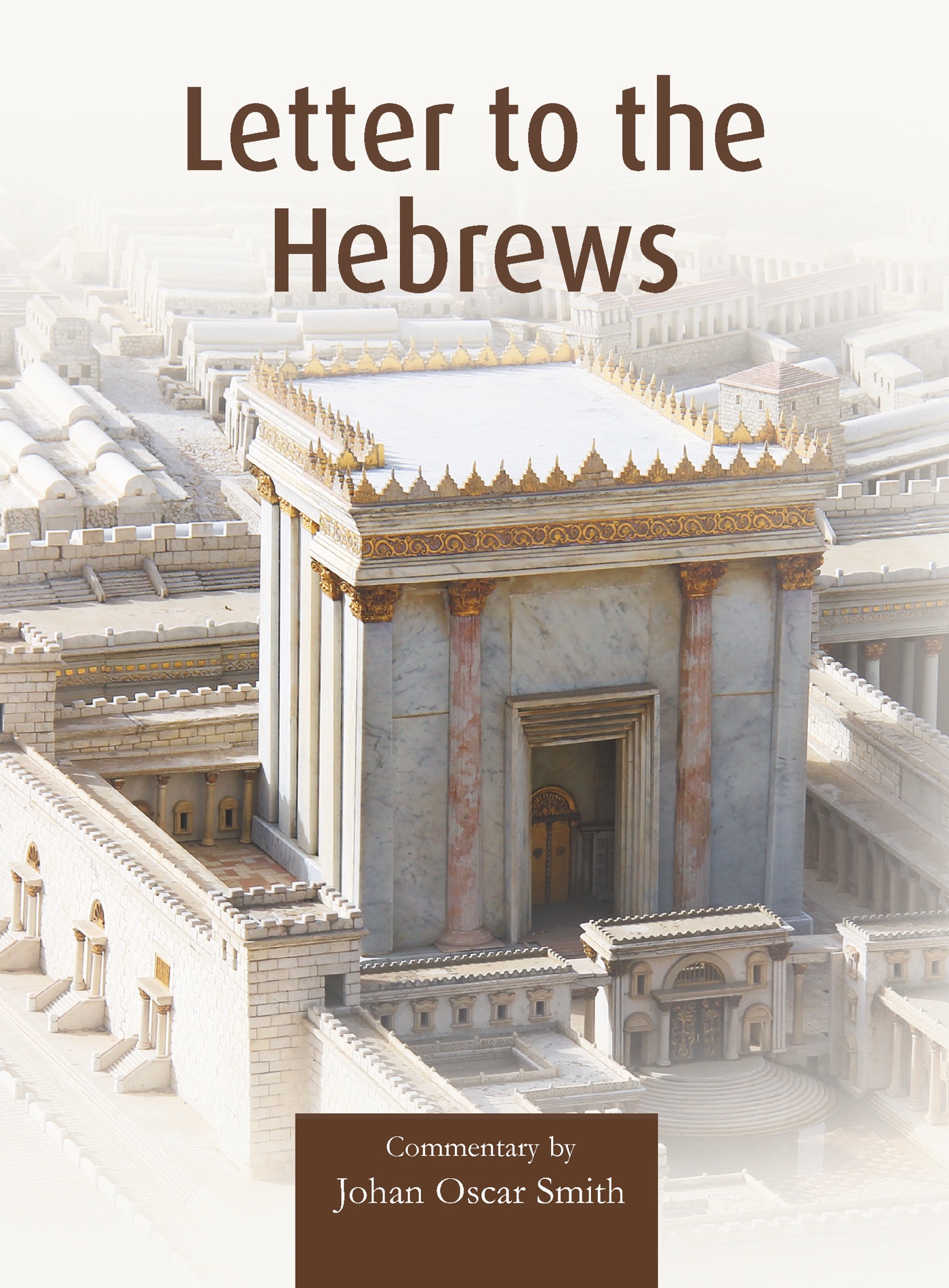
Chapter V
Verses 1-3. “For every high priest taken from among men is appointed for men in things pertaining to God, that he may offer both gifts and sacrifices for sins. He can have compassion on those who are ignorant and going astray, since he himself is also subject to weakness. Because of this he is required as for the people, so also for himself, to offer for sins.”
The service of all the priests reached its culmination in the service of the high priest. He himself was a human being who was appointed for people to minister to God. An angel could not carry out such a ministry. It had to be someone who was subject to weakness so that he could have compassion on the ignorant and wayward.
How wisely God arranges all things. He is compassionate and merciful toward all people. The way He ordered the priesthood testifies to that.
Verses 4-6. “And no man takes this honor to himself, but he who is called by God, just as Aaron was. So also Christ did not glorify Himself to become High Priest, but it was He who said to Him: ‘You are My Son, today I have begotten You.’ As He also says in another place: ‘You are a priest forever according to the order of Melchizedek’ . . . .”
God said: “You are My Son.” The angel of the Lord appeared to Joseph in a dream, while he and Mary were betrothed and before they had come together, and said, “Do not be afraid to take to you Mary your wife, for that which is conceived in her is of the Holy Spirit. And she will bring forth a Son, and you shall call His name Jesus, for He will save His people from their sins.” Matt. 1:19-21.
From this it is quite clear that Jesus is the Son of God and the son of Mary. He is the Son of God and the Son of Man. According to the flesh, He came of the seed of David, and was declared to be the Son of God with power according to the Spirit of holiness, by the resurrection from the dead. Rom. 1:3-4.
Here we see Christ manifested in the flesh. In this flesh of the seed of David, He fought His priestly battle against the flesh by the Holy Spirit. He offered Himself in the power of an eternal Spirit, and suffered death in the flesh but was thus made alive in the spirit. When the time came that He was perfected, He could say: “It is finished.” He had put off the flesh, which He gave for the life of the world, and had become a second Adam, a life-giving spirit, as opposed to the first Adam who became a living soul. Jesus also had this soul, but He poured it out. Once again we see the battle between flesh and spirit. Because His soul has labored, he shall see it (that the will of the Lord should prosper in His hand). This is the cause of all progress. If the will of the Lord does not prosper after a revival, then the people through whom the revival has taken place are nothing, and those who were revived are nothing. It is God’s will that is our sanctification.
“You are a priest forever according to the order of Melchizedek.” Who then was this Melchizedek?
“And the king of Sodom went out to meet him at the Valley of Shaveh (that is, the King’s Valley), after his return from the defeat of Chedorlaomer and the kings who were with him. Then Melchizedek king of Salem brought out bread and wine; he was the priest of God Most High. And he blessed him and said: ‘Blessed be Abram of God Most High, Possessor of heaven and earth; and blessed be God Most High, who has delivered your enemies into your hand.’ And he gave him a tithe of all.” Gen. 14:17-20.
After every spiritual victory, representatives from Satan’s kingdom and from God’s kingdom come and try to influence us. One is the king of Sodom. The other is Melchizedek, the priest of the Most High God. To whom shall we give the honor for the victory? The king of Sodom offered Abraham all the goods if only he could keep the people. Melchizedek blessed Abraham and strengthened him with bread and wine—an illustration of the flesh and blood of Christ. If Abraham had not had the mind of a shepherd but instead had been covetous he would have sold himself to the king of Sodom, accepted the goods and left the people with the king. Most probably the king of Sodom would later have used those same people to take the goods back from Abraham. But Abraham answered the king of Sodom: “I have raised my hand to the Lord, God Most High, the Possessor of heaven and earth, that I will take nothing, from a thread to a sandal strap, and that I will not take anything that is yours, lest you should say, ‘I have made Abram rich.’”
Here we see Abraham’s noble mind, a victorious mind. And here we see how Melchizedek ministers to a victorious soul. He strengthened Abraham with bread and wine. Jesus has overcome all principalities and powers. He is now sitting at the right hand of God as a faithful High Priest, and He always goes out to meet a victorious soul with bread and wine, with comfort and hope. Satan comes with honor (vain honor) and goods. How many preachers have allowed themselves to be fooled by rewards—the reward of the king of Sodom—and thus have sold the people for filthy lucre. By so doing they have rejected the blessing of Melchizedek together with his bread and wine. For this reason people do not know Jesus as the great High Priest according to the order of Melchizedek.
Verses 7-10. “Who, in the days of His flesh, when He had offered up prayers and supplications, with vehement cries and tears to Him who was able to save Him from death, and was heard because of His godly fear, though He was a Son, yet He learned obedience by the things which He suffered. And having been perfected, He became the author of eternal salvation to all who obey Him, called by God as High Priest ‘according to the order of Melchizedek.’”
Jesus was saved from death because of His godly fear. What was the death from which He was saved? He had to die for our sins, and yet He was saved from death. He suffered death in the flesh, but was made alive in the spirit. It was a tremendous battle for Jesus to be saved from the death that is referred to here. Jesus partook of flesh and blood just like the children. As a consequence of this He also fought the same battle that the children fight—namely, against temptations of every kind. With vehement cries and tears He offered up prayers in the days of His flesh. The temptations in the flesh were many and strong. If Jesus, in this long drawn-out battle in the days of His flesh, had yielded even slightly to sin, Satan would have had a part in Him, and then He would have come under the power of death. It was this power of death that Jesus overcame, so He was heard because of His godly fear. We, on the other hand, have not overcome death. That is why it is written that we have passed from death to life.
Wherever Jesus Christ enters into a person’s heart and is allowed to rule, then that person partakes of the same battle and sufferings. For this reason it is written: “And if Christ is in you, the body is dead because of sin, but the spirit is life because of righteousness.” Rom. 8:10. Jesus did not avoid physical death, but His spirit did not die. According to the spirit He was made alive. As such, He became the second Adam and a life-giving spirit. Jesus had to partake of flesh and blood, so that through death He might destroy him who had the power of death, that is, the devil, and release those who through fear of death were all their lifetime subject to bondage. This is the reason that we have now been set free from the power of death and have been delivered from death to life, from the power of Satan to God.
Jesus learned obedience by the things He suffered, and having been perfected, He became the author of eternal salvation to all who obey Him. It took time for Jesus to be perfected. It was during this time that He offered up prayers with vehement cries and tears. It wasn’t only in the garden of Gethsemane that He prayed and suffered; it was throughout His whole life. It was in the course of these prayers, supplications and victories that He was perfected to be High Priest. It was under these circumstances that He became the author of eternal salvation for all those who obey Him. It was because He was faithful in all things unto death that God called Him High Priest according to the order of Melchizedek.
Verse 11. “Of whom we have much to say and hard to explain . . . .”
The life our High Priest lived on this earth conveys to us the life we, as His followers, are to live. Jesus was trained to become our High Priest by His contentment and obedience. If we are dull of hearing, we cannot understand the work our High Priest did on this earth. His tears, prayers and supplications are foreign to us. However, if we obey Him who speaks from heaven, a battle ensues between flesh and spirit; then the High Priest intercedes on our behalf with His help and understanding, because He Himself was tempted and suffered in the flesh. But to explain spiritually weighty things to people who are dull of hearing is a difficult matter even though there might be much to say about these things.
Verse 12. “For though by this time you ought to be teachers, you need someone to teach you again the first principles of the oracles of God; and you have come to need milk and not solid food.”
By this time the Hebrews should have been teachers, but they had not been sufficiently attentive; they lacked godly fear.
The things that pertain to the mystery of godliness, that Christ was manifested in the flesh and justified in the spirit, were difficult for them to understand. They had had enough time to understand it, but their outward ear toward the world was more active than their inward ear toward God. That is why things went as they did. They could not bear strong meat but were still in need of milk. Christ as High Priest and the way in which God appointed Him High Priest were unclear for them. The reason was that the High Priest had gone through the veil—the flesh—and the Hebrews did not know enough about this new and living way, so not much could be said about it. It was too hard for them. They needed milk.
Verses 13-14. “For everyone who partakes only of milk is unskilled in the word of righteousness, for he is a babe. But solid food belongs to those who are of full age, that is, those who by reason of use have their senses exercised to discern between good and evil.”
We must exercise our senses to discern between good and evil. If a person’s love for God is great, he exercises himself in keeping God’s commandments. God’s laws are good, and everything that opposes His laws is evil. A little child can only receive milk, not solid food. It is a tragedy if they are still babes by the time they ought to be mature and able to bear solid food. Yet among Christians you can find virtually nothing but stunted babies who nonetheless are “mature” enough according to the flesh to speak evil of and warn people against God’s way.
That is why there are so many Christians wandering endlessly in the wilderness without ever entering into the land, without entering into God’s rest. Their life revolves around sin and grace all year long. If people were to take up their cross every day and follow Christ, there would be less sin and more of the grace that is not in vain. There would be more solid food and less milk. But who has the attitude of mind to follow the Lamb wherever He goes? Rev. 14:4.
'%3e%3cpath%20d='M6.54486%2022.9268C6.54486%2022.9268%206.53328%2022.9268%206.52749%2022.921L6.3789%2022.8188C6.36732%2022.811%206.36346%2022.7975%206.36732%2022.784C6.65292%2021.8925%206.79958%2021.3985%206.80151%2021.3946C7.50006%2019.1542%207.57532%2016.4585%207.01956%2013.6044C6.67222%2011.8233%206.53907%209.51924%206.53714%209.49608C6.32294%205.48423%207.3534%203.6568%207.98827%202.92351L8.02687%202.91772L8.17931%203.00456C8.19089%203.01228%208.19668%203.02579%208.19282%203.0393C7.99406%203.68189%207.87056%204.34956%207.87056%204.35535C7.42866%207.10132%207.83583%2012.0433%208.24878%2014.5172C8.67332%2017.0625%208.38579%2019.2411%208.38386%2019.2623C8.03073%2021.4274%207.09289%2022.483%206.56608%2022.9191L6.54678%2022.9268H6.54486Z'%20fill='black'/%3e%3cpath%20d='M17.0135%2026.4292C17.0135%2026.4292%2017.0019%2026.4292%2016.9961%2026.4234L16.8475%2026.3212C16.836%2026.3134%2016.8321%2026.2999%2016.836%2026.2864C17.0772%2025.5377%2017.2219%2025.0591%2017.2605%2024.9318C17.9648%2022.6682%2018.0439%2019.9609%2017.4882%2017.1088C17.1408%2015.3257%2017.0077%2013.0236%2017.0058%2013.0004C16.7896%208.9519%2017.8259%207.13604%2018.4627%206.41241L18.5013%206.40662L18.6518%206.49538C18.6634%206.5031%2018.6692%206.51661%2018.6653%206.53205C18.4646%207.17464%2018.3392%207.85582%2018.3392%207.86161C18.0845%209.4459%2018.1308%2011.6245%2018.2138%2013.1741L18.2215%2013.3227L18.3527%2013.2532C19.6437%2012.5797%2020.7069%2011.9005%2021.3708%2011.4509L21.4113%2011.4547L21.5271%2011.5782C21.5367%2011.5898%2021.5386%2011.6072%2021.5271%2011.6187C20.4464%2012.983%2018.4318%2014.4554%2018.3469%2014.5172L18.3141%2014.5422L18.3083%2014.5828C18.4125%2015.8641%2018.5572%2017.0779%2018.7136%2018.0234C19.1381%2020.5687%2018.8506%2022.7493%2018.8486%2022.7705C18.4955%2024.9356%2017.5577%2025.9912%2017.0309%2026.4273L17.0116%2026.435L17.0135%2026.4292Z'%20fill='black'/%3e%3cpath%20d='M10.9639%2028C10.9639%2028%2010.9484%2027.9981%2010.9446%2027.9923L10.8076%2027.8707C10.7979%2027.8611%2010.794%2027.8476%2010.7998%2027.836C11.2919%2026.5778%2011.5756%2025.804%2011.6277%2025.6612C12.7874%2022.5891%2012.9129%2018.9014%2011.9885%2014.9957C11.4116%2012.5566%2011.1877%209.39959%2011.1858%209.37064C10.7844%203.16664%2013.0344%200.750655%2014.0205%200H14.0591L14.198%200.111923C14.2077%200.121571%2014.2135%200.135079%2014.2077%200.148587C13.8005%201.09221%2013.5227%202.31564%2013.5207%202.32722C12.7874%206.08821%2013.4609%2012.8538%2014.1479%2016.2442C14.8561%2019.7389%2014.3756%2022.7203%2014.3717%2022.7512C13.704%2026.1185%2011.7782%2027.5407%2010.9812%2027.9961L10.9658%2028H10.9639Z'%20fill='black'/%3e%3c/g%3e%3cdefs%3e%3cclipPath%20id='clip0_3867_12532'%3e%3crect%20width='28'%20height='28'%20fill='white'/%3e%3c/clipPath%3e%3c/defs%3e%3c/svg%3e)