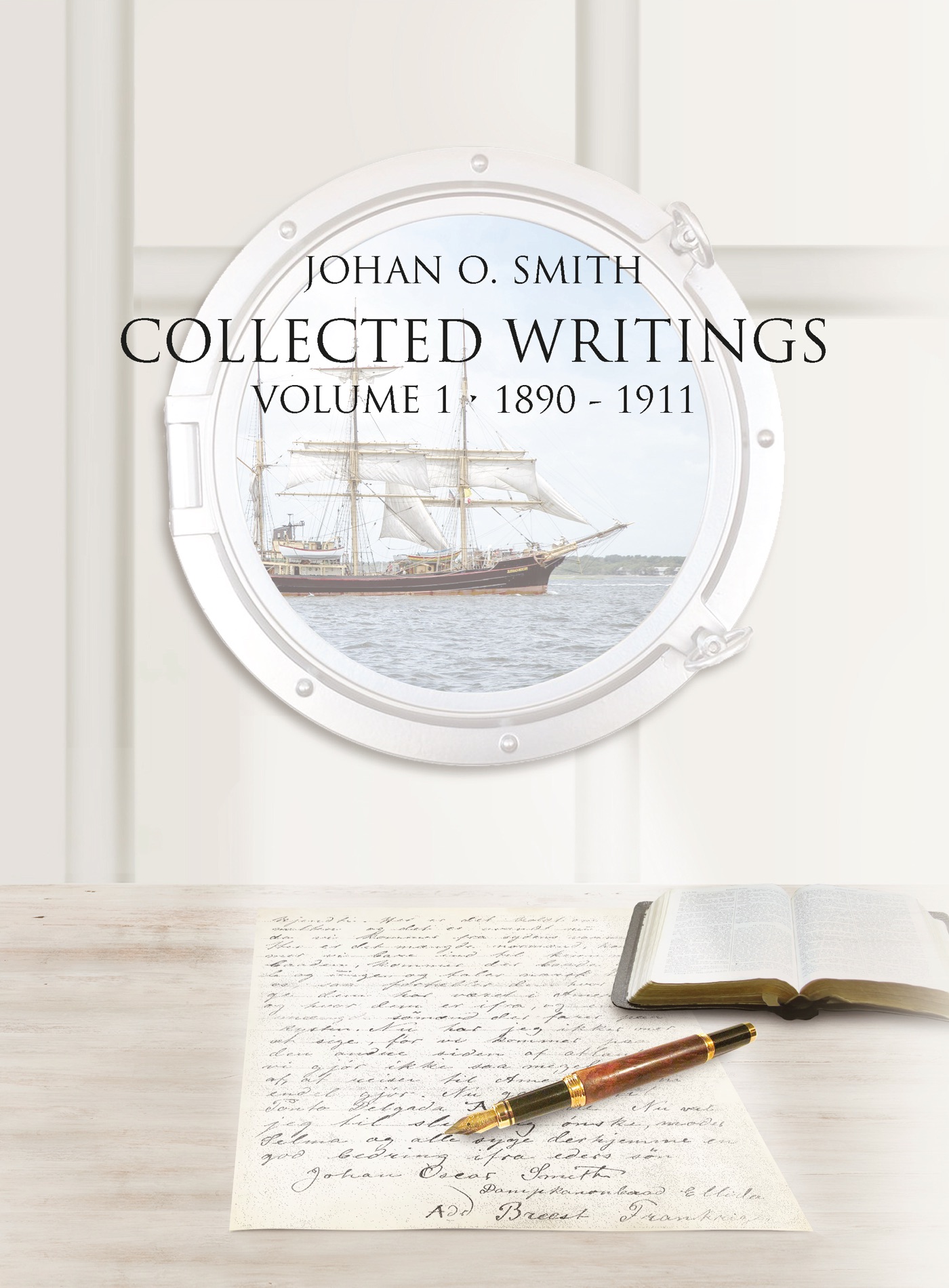
Among my writing materials, many,
No paper could be found.
No need to fret that there isn’t any.
I’ll use what I have around.
Br. Brungot has left for America. Kristian and I visited his wife and in-laws this morning. Brungot is sailing on board a yacht as a sailor, for which he’s paid 130 kr. a month plus board and clothing. He worked at the shipyard here, and last year during the mobilization he served on the Viking as a petty officer, Navy Reserve. Brungot was an adept fellow who had great insight in the knowledge of God. He was bold to speak out when necessary. He was a good writer, and he wrote to the newspaper about the fishing industry and the layoffs at the shipyard. He was laid off and had no other work here at home.
Br. Berg has been away on the Kong Sverre for one month now. Br. Ellefsen (gunner’s mate) is completing a technical training course, but he’s currently at home in Grimstad. Ellefsen is one of the quiet ones in the land. He and his wife have taken to heart everything we ourselves have taken to heart; they are rejoicing and have become established in the faith. Br. John writes often from Denmark. He is alone there. No one understands him, but he has peace.
God always gives us someone to speak with; this is also a labor in the Lord. There is always someone here or there who would like to speak with us. It’s always a great pleasure to meet such people, because they are few and far between. There has been some real friction between Br. Berg and me, and things had to come to a head. The issue that brought it to a head was this:
Br. Berg is of the opinion that Jesus, while He was on earth, did not have lusts and desires to fight against as we do. He believes that Jesus didn’t have inherited sin in His body. I am of the opinion that He did, but that He was always victorious over it. Everyone is tempted when he is drawn away by his own lusts and desires and enticed—and Christ was tempted. “Father . . . not My will, but Yours, be done.” Here we see that He had a will that was contrary to God’s will, a will that He denied by the Spirit. “For what the law could not do in that it was weak through the flesh, God did by sending His own Son in the likeness of sinful flesh, on account of sin: He condemned sin in the flesh . . . .” It was sin in the flesh—in the flesh of Christ—that was condemned. And now this same sin is condemned in all flesh. That’s why the world is convicted of judgment, because the prince of this world has been judged in the flesh.
Br. Berg says that Jesus was tempted from without, and that sin was laid upon Him from without. This sounds appealing, and most people have this understanding before they give it much thought. However, Christ was of the seed of the woman, and as such He had something within Himself to deny. He was obedient unto death, even the death of the cross. “Though He was a Son, yet He learned obedience by the things which He suffered. And having been perfected, He became the author of eternal salvation to all who obey Him.” In order for there to be obedience, there must be self-denial. And where there is self-denial, there is sin, because if a person has no sin, there is nothing to deny. Sin in the flesh had to be conquered, and that took place in Christ’s body, because no guile was found in His mouth. Much can be said about this. In Heb. 4:15 it is written that Christ was tempted in all points as we are, yet without sin. This tells us that He did not commit sin; He was faithful when He was tempted. But in order for Him to be tempted as we are, He had to have the same desires as we have; otherwise He could not have been tempted like we are.
The law could only address sin outside the body, but Christ crushed sin in the body. Therefore, our bodies belong to the Lord. He was wounded for all our transgressions; the chastisement was upon Him so that we could have peace. And yet, whether I kill one or a thousand, I have only one life to lose. It was the same for Christ. He suffered what a physical body could suffer, but one body couldn’t take upon itself the sufferings of several billion people. Many people err on this point. John and James were to be baptized with the same baptism and were to drink the same cup as Christ. Let us picture a flock of sheep hemmed in by four thick stone walls and imagine that one of the sheep breaks a hole in the wall and escapes. In so doing, this one sheep has opened the way for all the others to escape through the same hole. But if there is a stubborn goat among them who isn’t willing to go exactly the same way, it will have to die right where it is. If there are some who don’t believe that there is an opening, they, too, will have to die in their captivity. In this way, Christ has become the door of the sheepfold, and each and every one of us must go out through Him. In this way He is the Savior of the whole world. We have access through the veil—that is, His flesh. Now we can better understand why He is able to call us brothers.
Adam sinned, and through one man’s offense, condemnation came over all mankind. In the same way, through one Man’s obedience, the justification of life came over all men. You don’t glorify Christ by presenting Him as someone who was not like us. But Christ voluntarily inherited sin. He didn’t consider it robbery to be equal with God but humbled Himself and became like us. If I humble myself and become a shoe shiner, then that’s what I am, and I have to accept that I will be despised because that’s how people treat shoe shiners. If I can find a way out of my position as a shoe shiner to something better, I will have blazed a trail for all other shoe shiners, because if one can do it, it must be possible for everyone. The work of Christ is a deep work, one that angels desire to look into. It is hardly surprising that we understand only a little of it at a time. The way I understand it is that Christ was reckoned as a transgressor and died as one—not as all—so we may judge thus: if one died for all, then all died. In just the same way, one sinned for all.
Access to the same way is open to everyone—He is the way. Through the death of the One, there is access and escape from death. “To God the Lord belongs escapes from death.” All of us who want to be saved must share the same baptism and drink of the same cup. That’s why this death is called “the death of Christ.” We must go through this death (door), and no one gets through without having paid the last penny.
Kristian, Johanne, Pauline, and I are all doing well. My fondest greetings to you all.
Your son and brother,
Johan'%3e%3cpath%20d='M6.54486%2022.9268C6.54486%2022.9268%206.53328%2022.9268%206.52749%2022.921L6.3789%2022.8188C6.36732%2022.811%206.36346%2022.7975%206.36732%2022.784C6.65292%2021.8925%206.79958%2021.3985%206.80151%2021.3946C7.50006%2019.1542%207.57532%2016.4585%207.01956%2013.6044C6.67222%2011.8233%206.53907%209.51924%206.53714%209.49608C6.32294%205.48423%207.3534%203.6568%207.98827%202.92351L8.02687%202.91772L8.17931%203.00456C8.19089%203.01228%208.19668%203.02579%208.19282%203.0393C7.99406%203.68189%207.87056%204.34956%207.87056%204.35535C7.42866%207.10132%207.83583%2012.0433%208.24878%2014.5172C8.67332%2017.0625%208.38579%2019.2411%208.38386%2019.2623C8.03073%2021.4274%207.09289%2022.483%206.56608%2022.9191L6.54678%2022.9268H6.54486Z'%20fill='black'/%3e%3cpath%20d='M17.0135%2026.4292C17.0135%2026.4292%2017.0019%2026.4292%2016.9961%2026.4234L16.8475%2026.3212C16.836%2026.3134%2016.8321%2026.2999%2016.836%2026.2864C17.0772%2025.5377%2017.2219%2025.0591%2017.2605%2024.9318C17.9648%2022.6682%2018.0439%2019.9609%2017.4882%2017.1088C17.1408%2015.3257%2017.0077%2013.0236%2017.0058%2013.0004C16.7896%208.9519%2017.8259%207.13604%2018.4627%206.41241L18.5013%206.40662L18.6518%206.49538C18.6634%206.5031%2018.6692%206.51661%2018.6653%206.53205C18.4646%207.17464%2018.3392%207.85582%2018.3392%207.86161C18.0845%209.4459%2018.1308%2011.6245%2018.2138%2013.1741L18.2215%2013.3227L18.3527%2013.2532C19.6437%2012.5797%2020.7069%2011.9005%2021.3708%2011.4509L21.4113%2011.4547L21.5271%2011.5782C21.5367%2011.5898%2021.5386%2011.6072%2021.5271%2011.6187C20.4464%2012.983%2018.4318%2014.4554%2018.3469%2014.5172L18.3141%2014.5422L18.3083%2014.5828C18.4125%2015.8641%2018.5572%2017.0779%2018.7136%2018.0234C19.1381%2020.5687%2018.8506%2022.7493%2018.8486%2022.7705C18.4955%2024.9356%2017.5577%2025.9912%2017.0309%2026.4273L17.0116%2026.435L17.0135%2026.4292Z'%20fill='black'/%3e%3cpath%20d='M10.9639%2028C10.9639%2028%2010.9484%2027.9981%2010.9446%2027.9923L10.8076%2027.8707C10.7979%2027.8611%2010.794%2027.8476%2010.7998%2027.836C11.2919%2026.5778%2011.5756%2025.804%2011.6277%2025.6612C12.7874%2022.5891%2012.9129%2018.9014%2011.9885%2014.9957C11.4116%2012.5566%2011.1877%209.39959%2011.1858%209.37064C10.7844%203.16664%2013.0344%200.750655%2014.0205%200H14.0591L14.198%200.111923C14.2077%200.121571%2014.2135%200.135079%2014.2077%200.148587C13.8005%201.09221%2013.5227%202.31564%2013.5207%202.32722C12.7874%206.08821%2013.4609%2012.8538%2014.1479%2016.2442C14.8561%2019.7389%2014.3756%2022.7203%2014.3717%2022.7512C13.704%2026.1185%2011.7782%2027.5407%2010.9812%2027.9961L10.9658%2028H10.9639Z'%20fill='black'/%3e%3c/g%3e%3cdefs%3e%3cclipPath%20id='clip0_3867_12532'%3e%3crect%20width='28'%20height='28'%20fill='white'/%3e%3c/clipPath%3e%3c/defs%3e%3c/svg%3e)